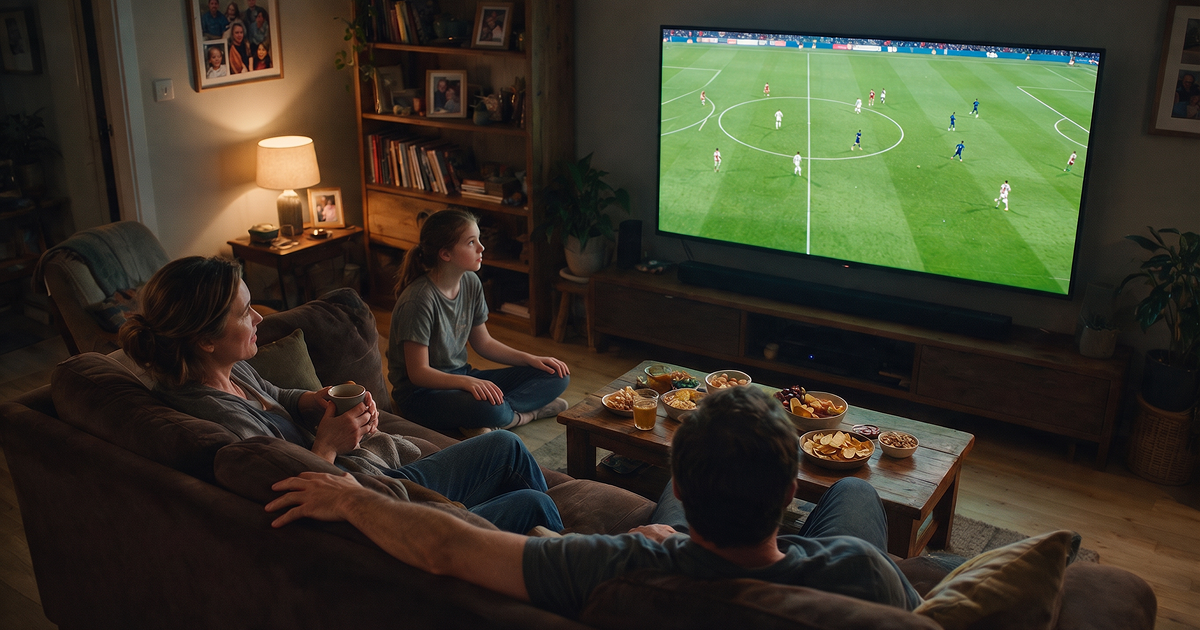
Brazil’s DTV+ (TV 3.0) entered commercial deployment during the 2026 FIFA World Cup, bringing 4K HDR, interactive services and a new app-based experience to free-to-air television.
But DTV+ has implications well beyond the Brazilian market. Its launch demonstrates how broadcasters can combine the reach of terrestrial television with the interactivity and personalization of broadband, while establishing a technology ecosystem that could support streaming services and operators worldwide.
At IBC 2026, Globo’s Carlos Cosme and V-Nova’s Fabio Murra discussed the challenges of bringing DTV+ to market, the lessons learned and what the project could mean for the future of broadcasting.
DTV+ combines free-to-air broadcasting with broadband services through an app-based TV experience, creating new opportunities for audience engagement, personalized content and advertising.
During the World Cup, Globo introduced live match statistics, interactive polls and on-demand highlights alongside traditional television coverage. Some of the new features work uniquely without an internet connection, while broadband enables an even more personalized experience.
The launch required close coordination between broadcasters, technology suppliers and device manufacturers. Teams also had to balance video quality, latency and bitrate within terrestrial bandwidth constraints, while ensuring straightforward indoor reception and an intuitive experience for viewers.
DTV+ uses the most advanced MPEG codecs: VVC enhanced with MPEG-5 LCEVC to deliver 4K HDR within the terrestrial bandwidth limits.
LCEVC adds a low-complexity enhancement layer to the base codec, improving compression efficiency without replacing the underlying technology.
During the World Cup, the system delivered 4Kp60 HDR at bitrates below 10 Mbps using indoor antennas.
Compatible set-top boxes supporting VVC and LCEVC became available on the Brazilian market ahead of the World Cup, after the finalization of the TV3.0 standard’s receiver profile in 2025, demonstrating how industry collaboration helped bring the new broadcasting system to market in record time.
The hardware platforms developed for DTV+ are not limited to Brazil. The same chipsets are used in set-top boxes and TVs worldwide. Commercial encoders are also the same used in broadcast, payTV and streaming services in other markets.
In the case of LCEVC, as LCEVC is base codec-agnostic and can enhance other codecs present on the device, including AVC, HEVC, AV1, this creates opportunities across broadcast, PayTV and streaming services that are not yet using VVC.
Beyond the technology itself, Brazil’s experience highlights the value of coordinated industry collaboration and shared objectives in bringing next-generation technologies to market. With growing international cooperation and a commercial hardware ecosystem becoming established, DTV+ offers valuable lessons for broadcasters and operators considering the future of television.